Hammer Throw: Technique, Weights & How the Event Works
Quick answer: The hammer throw is a rotational throwing event where the athlete swings a ball on a wire and handle through 3–4 turns inside a 7-foot circle before release. Men throw a 16 lb (7.26 kg) hammer; women throw a 4 kg (8.8 lb) hammer. The event breaks into three phases: the winds, the turns, and the release.
Hammer Weights by Level
| Level | Boys / Men | Girls / Women |
|---|---|---|
| High School / USATF Youth | 12 lb | 4 kg |
| College / Olympic / International | 16 lb (7.26 kg) | 4 kg (8.8 lb) |
| Indoor Weight Throw | HS 25 lb • College 35 lb | 20 lb |
The Three Phases of the Hammer Throw
The hammer throw is divided into three main phases, each with challenging technical components: the start and winding action, the turns, and the release.
Circle degrees. When teaching the hammer, the 360 degrees of the circle are used as reference points: 0/360 degrees at the back of the circle, moving counter-clockwise, with the front of the circle at 180 degrees.
Start and Winding
The thrower sets up in the back of the circle with the feet shoulder width apart, facing the opposite direction of the throw with the bodyweight balanced.
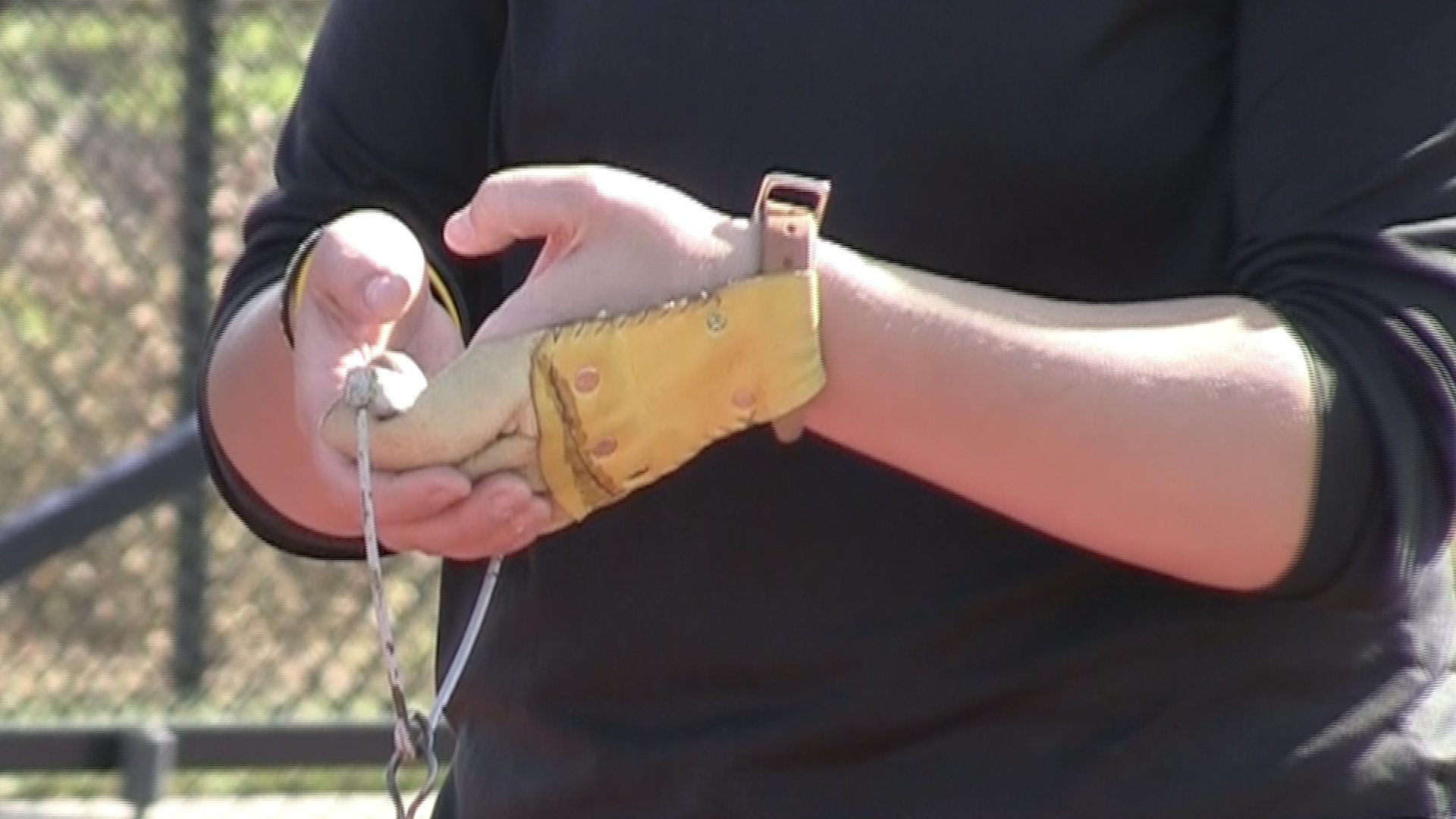
The hammer is gripped with the left hand on the handle, fingers curled together at the distal interphalangeal joint; the right hand covers the left hand. Hammer throwers wear a glove or tape on the fingers of the left hand because of the force against the fingers during the throw.
The most common starting position places the implement off the right side of the thrower with the handle resting near the left hip. The hammer should rest just inside the ring with the arms straight across the body. To start, the body weight shifts left and the shoulders turn right, then the hammer lifts off the ground across the center of the body to the far left to begin the winding action.
The hammer moves in a circular pattern during the winds and turns called the orbit. The highest point of the orbit is near 180 degrees and the lowest point near 360 degrees during the turns. The winding action accelerates the hammer and sets up the optimal orbit. Most throwers execute two winds before the right foot picks to initiate the turns. During the winds, body movements counterbalance the swinging hammer, keeping bodyweight opposite the implement — the thrower stays tall with just enough lower-body shift to counteract the ball.
After the hammer is directed up and to the left, the right wrist curls down on top of the left wrist, raising the right elbow. The shoulders turn right as the left elbow rises, the hands pass over the head near the right ear, and the hands and hammer stretch behind the right side. The hammer drops behind a solid, flat right foot, setting up the first low point off the thrower's right side.
The hammer is pushed from behind the thrower, off the right leg, then extended out front with both arms long — the orbit runs back-to-front, not up-and-down. The hammer is pushed left and rises as the shoulders turn right; the hands move upward before reaching back behind, repeating the first wind's action. On the final wind, the thrower drops and sits with the lower body, keeping bodyweight against the ball as the implement is directed forward, with the low point at 360 degrees as the turning action begins. The upper body and hammer move together with the head centered as one system. The shoulders push out, concaving the chest, to lengthen the effective radius of the hammer system.
The orbits during the winding action should stay relatively flat, especially for novice throwers.
Hammer Turns
Hammer throwers typically use 3 to 4 turns to accelerate the implement into the release. Entering the first turn, the hammer moves out and to the left. After the hammer passes 0 degrees, the thrower drives to 90 degrees turning on the ball of the right foot and the heel of the left foot.
The left leg stays flexed as the thrower moves left before the right foot picks up. When the hammer reaches 90 degrees, the right foot lifts and turns in to step over the top of the left foot. The legs must stay close together with the knees tight on every turn. The left foot rolls from the heel to the middle outer edge to the front outer edge — the left leg is the pivot point, and keeping ground contact with the left foot keeps the thrower stable and balanced. During the heel-toe turning action, both feet are synchronized, moving together to maximize efficiency.
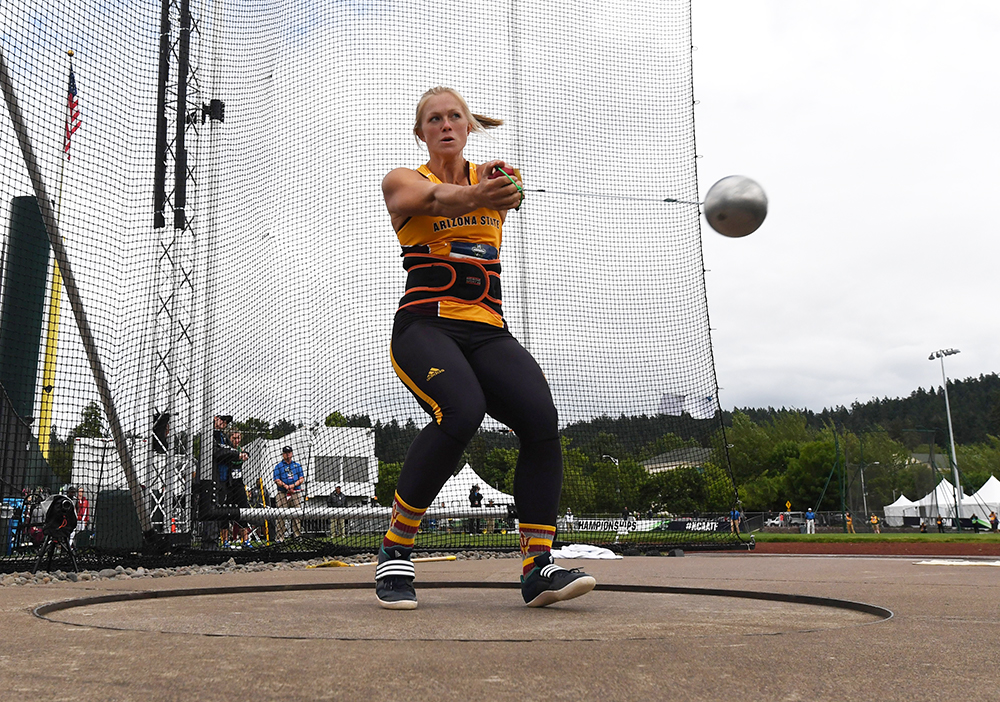
The right foot quickly steps to 270 degrees as the left knee drops down. Most throwers plant the right foot flat on the first turn to keep bodyweight against the hammer on the left side. The upper body stays long, and the hammer should be caught (right foot touchdown) at 230–260 degrees on the first turn to create separation between the lower and upper body. The hammer throw is the only event with multiple power positions — after each catch, the thrower lands in a power position to apply force to the implement.
The implement accelerates from the catch to the low point by ‘stroking’ the hammer with the right side of the body and arms, aided by gravity as the ball descends. The hammer drives down to 0 degrees; as it drops, the thrower counteracts the force by moving the body opposite the ball. If the hammer is low, stay more upright; when the hammer is high, stay down with the lower body and drop the left knee under the hammer on each catch.
With each turn, both feet stay grounded to approximately 90 degrees, then the right leg drives up and plants near 270 degrees — usually on the ball of the right foot in later turns. After each turn the hammer is caught further back: 230–260 degrees on the first turn, near 220 degrees by the final turn. The further back the catch, the greater the force that can be applied to the ball.
Delivery
After the final catch, the thrower drives the hammer down into the low point, then turns the right side into a firm left side, creating a blocking action. The thrower extends up onto the left leg while finishing with the arms to release the hammer. After release, regain balance by dropping the center of gravity and moving away from the front of the circle.
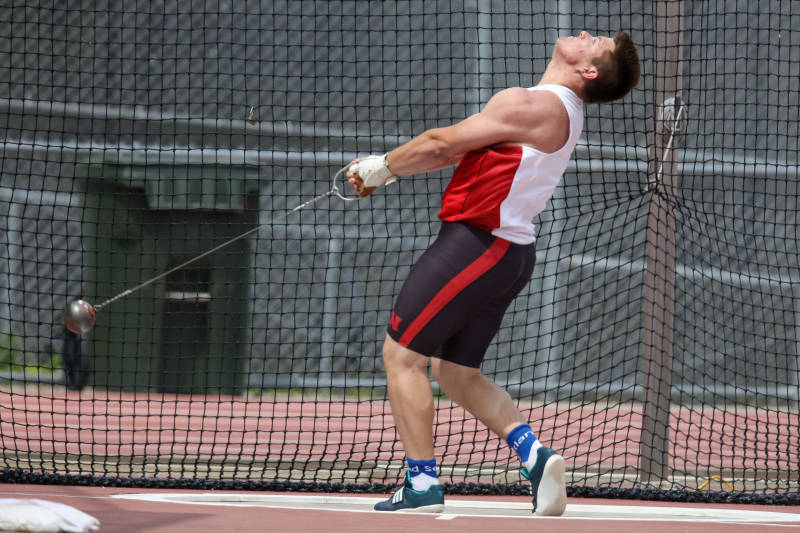
Coach's note: Novice hammer throwers learn to turn on the heel of the left foot using a three-turn technique. Most advanced throwers use four turns; some perform a toe turn on the first turn to save space in the ring, while a few advanced throwers with smaller feet can execute four heel turns.
Hammer Throw FAQ
How heavy is a hammer in track and field?
The men's hammer weighs 16 lb (7.26 kg) at the college, Olympic, and international level; the women's hammer weighs 4 kg (8.8 lb). High school and USATF youth boys throw a 12 lb hammer.
How many turns do hammer throwers take?
Three to four. Beginners learn a three-turn technique on the heel of the left foot; most advanced throwers use four turns.
Is the hammer throw a high school event?
Only in a few states — most high school hammer throwers compete through USATF and AAU club meets. The indoor weight throw fills a similar role during the indoor season.
What is the difference between the hammer and the weight throw?
The weight throw is the indoor version: a heavier ball on a shorter handle — 35 lb for college men, 25 lb for high school boys, and 20 lb for women — thrown with the same turning technique.